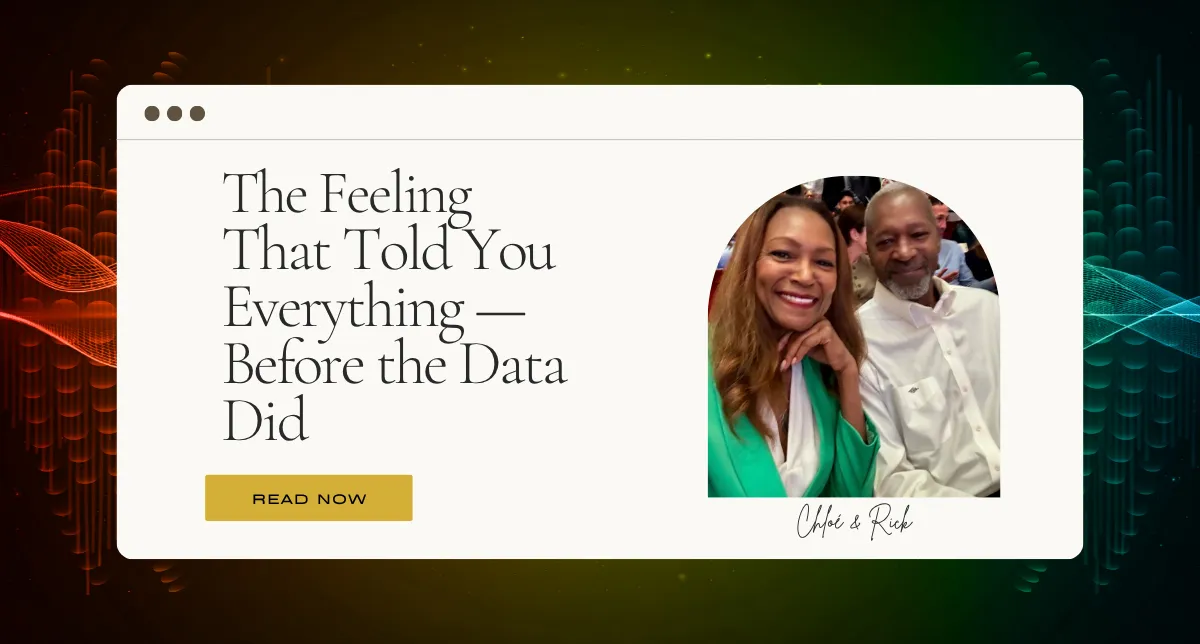
The Feeling That Told You Everything — Before the Data Did
On communion, quiet cracking, and why HR leaders can't afford to lose their own signal
Reading time: 8 minutes
The music hit first.
Not background music. Not ambient sound to fill the silence before service begins. Music that moves through you before your mind has time to organize an opinion about it. The kind that vibrates in your chest cavity and stirs something older than language.
This past Sunday I sat inside Our Lady of Lourdes — the oldest African American Catholic Church in Atlanta — and I felt it.
Then the moment came — the one Catholics know — when you turn to the people beside you and say, "Peace be with you."
At Our Lady of Lourdes, they mean it.
Not as a liturgical formality. Not as the socially acceptable version of a handshake with strangers in a pew. They mean it the way people mean things when they've genuinely decided to show up for each other. I felt known. Not performed at. Not networked with. Known. Embraced, not just welcomed. Home, not just attended.
It was communion.
Now here's what I want you to sit with for a moment, because it is not a small thing.
Since the earliest days of the church, leaders had cautioned against music that was designed to stir up feelings. Clement of Alexandria called emotionally evocative music dangerous — something that leads to "changefulness." Augustine himself was greatly moved by singing psalms but feared the pleasure it gave him. Early Christians actively discouraged all outward signs of excitement and, from the very beginning, in the music they used, reproduced an inward quietude.
They wanted order. They wanted control. And they understood, even then, that music which moves through the body awakens something in people — a capacity to feel, to perceive, to know — that is very difficult to manage once it's been stirred.
That fear did not stay in the early church. It traveled.
After the Stono Rebellion of 1739, in which enslaved people used a drum to signal each other, drums were subsequently banned. Fearing the use of loud instruments to communicate rebellions, Europeans created laws in the Americas to prohibit large numbers of enslaved people from gathering. Drums were banned because they were seen as especially dangerous — drum sounds were linked to language and gave enslaved people a way to communicate that could not be controlled or understood by those who held power over them.
Read that again slowly.
The drum was banned not because it was noise. It was banned because it was signal. Because it created communion between people. Because it awakened awareness. Because people who could feel deeply, communicate freely, and recognize each other across a field — those people were far harder to keep still.
Singing became the superpower that freed their souls. It reaffirmed their somebodiness in a world that treated them as less than human. Hidden meetings took place in remote areas — woods, cabins, secluded clearings — where enslaved people could pray, sing, and testify without fear of punishment, creating a spiritual community rooted in shared struggle and hope. They called it the invisible church.
They were not about to let anyone silence the signal.
The music that moved through me at Our Lady of Lourdes on Sunday morning is the direct descendant of that refusal. Every note carries the memory of people who sang when singing was dangerous, who felt when feeling was forbidden, who communed when communion was against the law.
And when we turned to each other and said "Peace be with you" — and meant it — we were doing something that has always been, on some level, an act of resistance.
Because being fully present with yourself and with another human being has never been entirely convenient for systems that require compliance over consciousness.
The drum was banned not because it was noise. It was banned because it was signal.
I've been inside enough rooms to know that what I felt Sunday is not the standard.
I've been in plenty of churches — and plenty of organizations — that were technically communities. Well-designed. Well-intentioned. Full of people. Covered dishes. Name tags. Carefully planned "connection moments." And about as warm as a conference breakout session with good catering.
Community is proximity. Communion is contact. You can have a room full of people and not a drop of the second. Most organizations have mastered the first and quietly given up on the latter — or worse, convinced themselves that a quarterly offsite counts.
Here's what struck me as I sat there: the loneliness epidemic bleeding billions out of American workplaces every year isn't because people are physically isolated. It's because they're spiritually isolated — from each other and, more urgently, from themselves.
You can't commune with anyone else when you've lost contact with yourself.
Two Signals Worth Reading — Especially If You Work in HR
Two things are converging in leadership data right now that, taken together, tell a story the market hasn't fully named yet. SHRM has been tracking both. And if you're in HR, what I'm about to say is either going to feel like a relief or a reckoning. Possibly both.
The first: there is a term gaining real traction in HR and leadership research called quiet cracking. It's different from quiet quitting — and frankly, it's more expensive. Quiet quitting was at least a decision. Somebody chose to disengage. Quiet cracking is the absence of a choice. It's what happens when a leader's internal structure slowly collapses under compounding pressure while they continue to function on the outside. No announcement. No dramatic exit. Just a slow, invisible erosion of motivation, confidence, and the capacity to feel located inside their own work.
SHRM's research found that 51% of employees feel used up at the end of the workday. Forty-five percent feel emotionally drained. Not occasionally. Regularly. And this is happening most acutely in the middle of the organizational structure — in the managers and people leaders being asked simultaneously to integrate AI, develop culture, retain talent, coach their teams, and deliver results. Often without clear roles, sufficient authority, or a single person above them asking, "Hey — how are you actually doing?"
HR leaders, I'm talking to you directly now.
You are the ones being asked to solve this. You're building the programs, holding the data, designing the interventions. You are — bless your hearts — trying to architect belonging for entire organizations. And the question nobody is asking you loudly enough or honestly enough is whether you've lost your own signal in the process.
Because here's the thing: you cannot architect coherence for others from inside your own distortion. You just can't. That's not a judgment — that's physics.
The second: the definition of professional confidence is shifting, and shifting fast. New research on leadership in the age of AI is surfacing something that sounds simple once you hear it but lands with real weight: confidence is no longer about having the answer. The days of performing certainty as a leadership strategy are quietly over. What's replacing it is something far more interesting — and far more demanding.
Confidence is now a perception function.
It's about how accurately you can see — the situation, the data in front of you, your own center, and the gap between where you are and where you're trying to lead. The leaders who are thriving right now aren't the most informed people in the room. They're the most coherent. They can receive information, hold it against their own discernment, and decide from truth — rather than from noise, pressure, or the version of themselves trained to always appear like they know.
That coherence doesn't come from a certification or a framework. It comes from a practiced ability to hear your own signal clearly — and trust it.
Which brings me back to Sunday morning. And what I felt in that room.
The Signal Your Gut Has Been Sending
The leaders who are quietly cracking aren't failing to try. They're failing to feel — not in the emotional collapse sense, but in the diagnostic sense. They've stopped receiving the data their own interior is transmitting. The restlessness that says something's off. The low-grade dread that says I'm performing, not leading. The erosion of confidence that says I'm deciding from fear, not from knowing.
These aren't personal failures. They're frequency signals. And feelings — when you know how to read them accurately — are among the most precise diagnostic instruments available to any leader.
The Frequency of Feelings is a premise I've built decades of work on: your feelings carry information. They are the body's real-time reporting system on the state of your alignment — between who you are and how you're operating, between what you know and what you're being required to perform.
When HR leaders stop reading their own signal, two things happen. They lose access to the gut intelligence that makes them extraordinary at what they do. And they lose the ability to recognize that same loss in the people they're trying to support. You can't hear someone else's frequency when yours is full of static.
The early church tried to quiet the signal. The slaveholder tried to silence the drum. The modern workplace — with its performance culture, its managed emotions, and its professional-distance norms — does a version of the same thing every single day.
And every time, the people who find a way to feel anyway — accurately, intelligently, without apology — are the ones who lead from somewhere real.
The class where they taught you to trust that signal? It didn't exist. They taught you everything about the world outside you. Everything except how to read the world within you.
That's exactly why we built one.
Trust Your Gut — A Live Experience for the People Behind the People Strategy
On April 22nd, I'm hosting a live experience specifically designed for HR leaders and People professionals who are ready to stop operating from outdated self-understanding and start leading from accurate self-perception.
We'll work through The Life Trifecta — Value Self, Perceive, and Decide — the three abilities that form the root of gut trust and the foundation of real coherence. Not as concepts. As a lived, measurable experience. You'll arrive having already completed the Personal Excellence Profile, a 200-question diagnostic that maps your 12 life abilities and produces your own PEP graph. You'll walk into the session already holding your mirror.
This is not a webinar. It's a diagnostic experience. Built for leaders who are accomplished on the outside and quietly out of alignment on the inside — who sense that the next level isn't a strategy problem. It's a perception problem.
The peace you're looking for at work? It starts with knowing yourself well enough to actually bring yourself into the room.
Your feelings have already been telling you that.
→ Register for Trust Your Gut — April 22nd | $97 | Live via Zoom
→ Take the Frequency of Feelings Quiz
About the Author
Chloé Taylor Brown is the Founder & CEO of The PEP Institute — a wisdom-tech company building perception infrastructure for leaders, teams, and organizations in the emerging Wisdom Economy. A former international fashion model, author of four books, executive coach, and systems innovator, Chloé's work spans identity, embodiment, leadership, spiritual intelligence, and human development.
She is a speaker on Women in Tech, AI and authenticity, and the Wisdom Economy — and the creator of the Personal Excellence Profile Assessment, the 12 Abilities Framework, the 8 Zones diagnostic architecture, and the Frequency of Feelings.
Her authority is not borrowed from trend or jargon. It is lived, refined, architected, and embodied.
→ Learn more about Chloé and The PEP Institute → Take the Frequency of Feelings Quiz → Register for Trust Your Gut — April 22nd
© 2026 The PEP Institute. All Rights Reserved.


