Perception Infrastructure for Modern Leadership
As technology accelerates, leadership requires more than access to intelligence. It requires leaders who can see clearly, understand how they are operating now, strengthen distinctly human capability, and make increasingly complex decisions from alignment rather than assumption.
The Corporate Moment
Organizations are navigating AI adoption, changing roles, leadership transitions, restructuring, faster decision cycles, and new expectations for human-machine collaboration. The challenge is no longer simply whether people can use the technology. It is whether the people responsible for leading with it are clear, aligned, and equipped for what the environment now requires.
More technology does not automatically create greater human clarity.
We’ve spent enormous energy upgrading the technology. Who is upgrading the human being responsible for leading with it?
The Hidden Human Layer
Human Alignment is the relationship between who a leader is now, how that leader is currently operating, the human abilities available in the moment, and what the present environment requires. It is the hidden layer influencing how people see, choose, communicate, relate, act, and lead.
Misalignment can exist beneath excellent credentials, strong performance, and impressive results. What is visible is not always the whole story.
What a leader notices, interprets, assumes, and may not yet be seeing clearly.
How choices are made under pressure, uncertainty, complexity, and accelerated change.
How clearly intention, direction, expectations, and meaning are transmitted to others.
The quality of connection, credibility, rapport, and relational confidence inside the room.
Whether insight becomes intentional movement, hesitation, overreaction, or stalled execution.
How effectively clarity, capability, and commitment translate into meaningful results.
How inner state becomes visible through confidence, certainty, language, energy, and behavior.
The ability to remain clear, responsive, and human while the environment continues to change.
Human Alignment begins by making the current operating state visible — so leaders and organizations can work with what is actually happening, not merely what performance suggests should be happening.
Three Executive Questions
In periods of accelerated change, leadership cannot rely only on strategy, expertise, or more information. The deeper work is determining who the leader must be, which human capabilities the moment requires, and how decisions can be made with greater clarity.
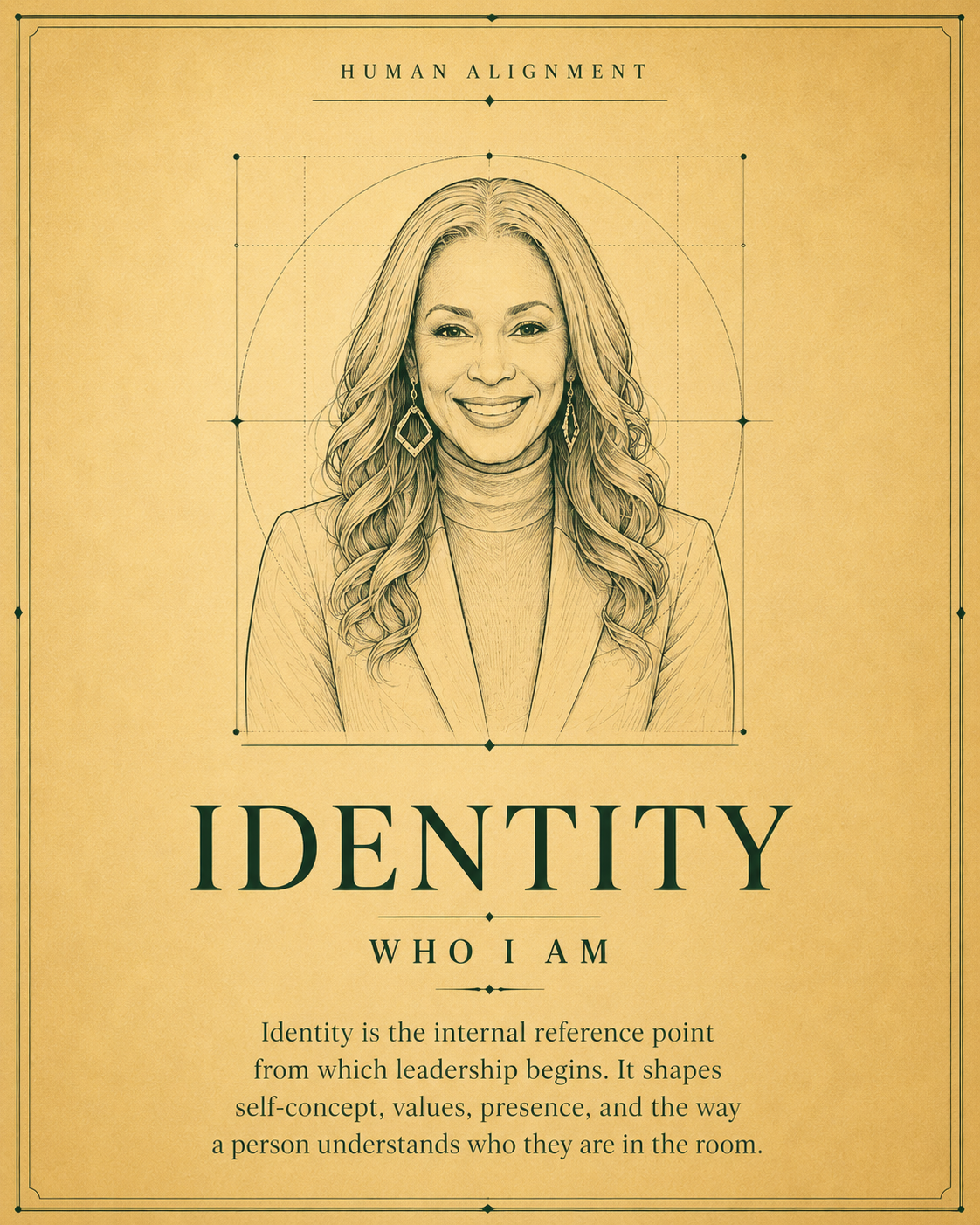
Identity
The role may be familiar. The version of you required to lead it may not be.
Who you were when you entered the role may not be who the next chapter requires. Human Alignment helps leaders recognize when identity, behavior, expectations, and present responsibility are no longer operating in sync.
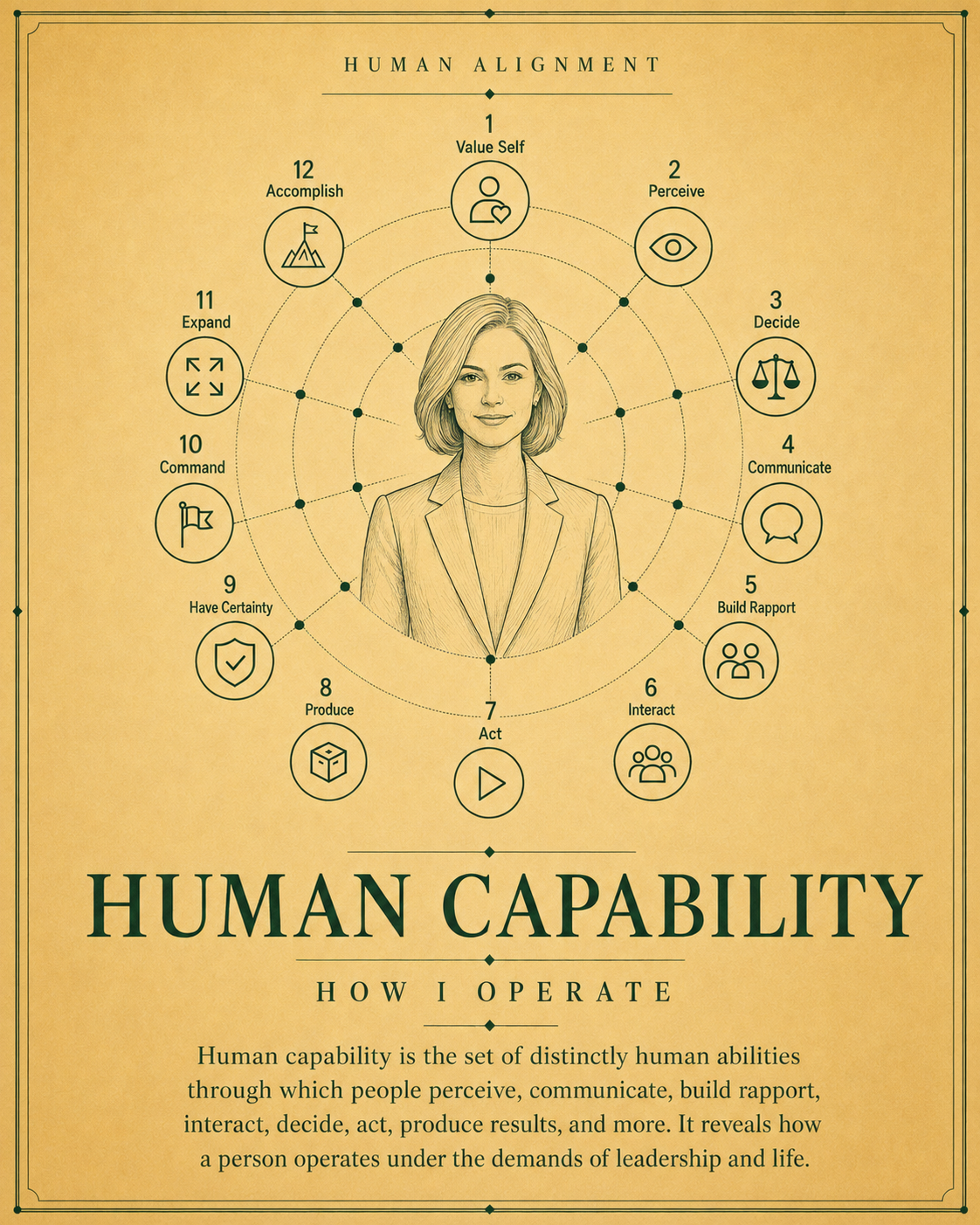
Human Capability
AI can extend intelligence. It cannot practice being human for us.
Leadership still depends on human capacities such as perception, judgment, communication, rapport, certainty, action, presence, and the ability to move people through complexity with trust and clarity.
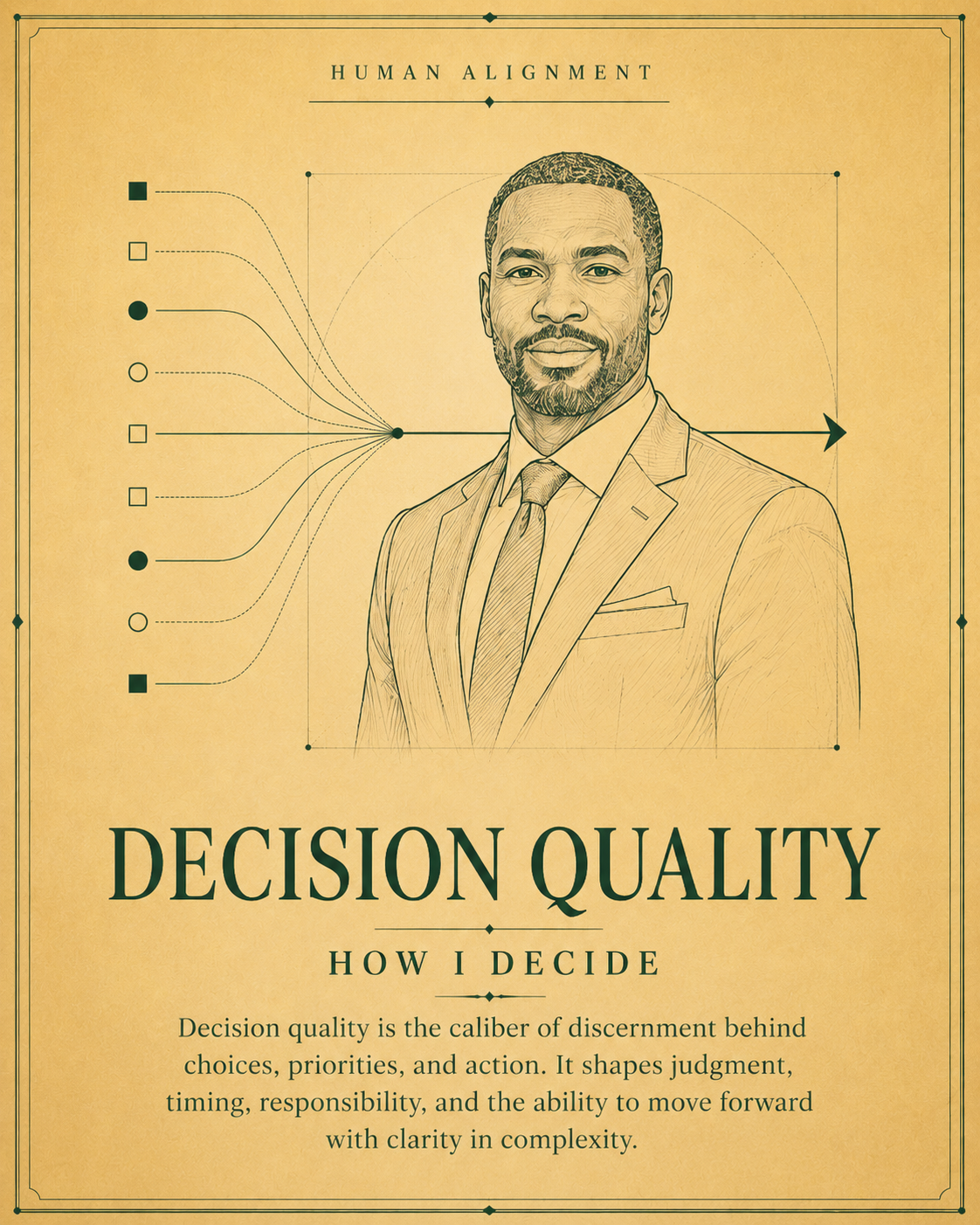
Decision Quality
More information does not automatically create clearer leadership.
Decision quality depends not only on what leaders know, but on how clearly they perceive the situation, how they interpret pressure, what assumptions are operating, and the state from which the decision is being made.
Human Alignment begins where identity, human capability, and decision quality meet the demands of the moment.
The Human Capability Framework
The Personal Excellence Profile™ organizes human functioning across 12 Human Abilities — revealing how people are currently operating across the dimensions that shape leadership, relationships, execution, and growth.
The ability to recognize personal worth, capacity, and potential without diminishing self.
The ability to see clearly, interpret accurately, and recognize what is actually present.
The ability to make choices with clarity, judgment, responsibility, and intentional direction.
The ability to convey thought, intention, meaning, and direction with clarity and precision.
The ability to create connection, trust, resonance, and relational understanding with others.
The ability to engage effectively with people, environments, dynamics, and changing conditions.
The ability to move from awareness and intention into timely, purposeful action.
The ability to turn effort, ideas, resources, and action into meaningful output and results.
The ability to hold inner conviction, clarity, and confidence without requiring constant external reinforcement.
The ability to direct attention, energy, language, resources, and leadership with authority.
The ability to increase capacity, perspective, influence, possibility, and range.
The ability to bring meaningful intentions, priorities, and goals through to completion.
Together, the 12 Human Abilities make the human operating pattern visible — creating a shared language for understanding how leaders and teams are functioning now and what may need to strengthen next.
The Diagnostic Infrastructure
Human capability is difficult to strengthen when leaders and organizations cannot clearly see what is operating now. The Personal Excellence Profile™ provides a measurable current-state view across 12 Human Abilities and 8 Frequency Zones — revealing patterns beneath performance, role, title, and outward success.
Current-State Diagnostic Mirror
The Personal Excellence Profile™ helps make visible the human patterns influencing perception, decision-making, communication, relationships, action, production, certainty, leadership, expansion, and accomplishment.
It does not label who someone is. It reveals what is operating now.
PEP does not place people into fixed categories. It creates a mirror for the patterns, strengths, pressures, and operating tendencies present now.
Strong results can coexist with hesitation, identity shifts, communication pressure, strained certainty, or emerging leadership liabilities.
A diagnostic framework gives leadership teams a more precise way to discuss capability, alignment, development, and the human state beneath strategic execution.
See what is operating now — beneath title, performance, credentials, and the external picture of success.
Identify where strength, pressure, blind spots, liability, and misalignment may be influencing leadership and execution.
Determine what requires attention next — alignment, development, coaching, executive intervention, or organizational expansion.
The Personal Excellence Profile™ turns Human Alignment from an abstract idea into something leaders and organizations can begin to see, name, and work with.
Ways Organizations Engage
Human Alignment can begin with a senior leadership conversation, a focused decision lab, or deeper executive diagnostic work. The right starting point depends on what is changing, who is carrying the pressure, and what the organization needs to see more clearly.
Executive Briefing
90-Minute Senior Leadership Experience
A focused executive conversation that helps senior leaders understand the human implications of accelerated change and identify where alignment may be affecting leadership, decision quality, communication, and execution.
Especially valuable for
Executive Decision Alignment Lab
Half-Day Executive Working Session
A deeper facilitated experience designed to examine leadership identity, human capability, decision quality, and the current operating patterns influencing a consequential business moment.
Especially valuable for
Executive Alignment™
Individual Executive or Leadership Cohort
A deeper alignment experience powered by the Personal Excellence Profile™. It helps leaders see their current operating state, clarify what the role now requires, and strengthen the human abilities most relevant to the next level of leadership.
Especially valuable for
The first conversation is designed to understand the environment, the leadership pressure, and what is currently at stake — then determine the right level of engagement.
Trigger Moments
Alignment work becomes especially important when a familiar way of leading, deciding, communicating, or operating is no longer enough for what comes next. These moments often expose the gap between yesterday’s leadership pattern and tomorrow’s expectation.
When technology changes workflows, expectations, responsibilities, decision speed, and the definition of human contribution.
When a high-performing leader steps into greater authority, visibility, complexity, or responsibility.
When reporting structures, priorities, responsibilities, or team relationships are being redesigned.
When different cultures, leadership assumptions, decision patterns, and ways of working must become coherent.
When leadership continuity depends on more than readiness for the role — it depends on readiness for the identity and responsibility.
When capable leaders need to rebuild clarity, trust, shared language, decision discipline, and collective direction.
When the title may remain familiar but the actual expectations, authority, interfaces, and human capabilities required have changed.
When a leader is entering, exiting, evolving, or recalibrating inside a consequential new chapter.
Human Alignment is particularly valuable when yesterday’s way of leading can no longer carry tomorrow’s expectations.
The question is not simply, “What is changing?” It is also, “What must change in the human operating system responsible for leading through it?”
What Changes
Human Alignment creates the conditions for leaders and teams to operate with greater clarity, precision, and intentionality. The goal is not simply to know more. It is to see more accurately, choose more consciously, communicate more clearly, and move with greater alignment.
Leaders become more aware of how they are currently operating, what is influencing their choices, and where a familiar pattern may no longer serve the role.
Leaders can more intentionally strengthen the distinctly human abilities required for the work, the role, the team, and the environment now in front of them.
Decisions become less reactive and more grounded in clearer perception, stronger judgment, greater awareness, and a more aligned operating state.
Leaders become better able to communicate intention, expectations, direction, complexity, and change with greater clarity and less unnecessary friction.
Insight is more likely to become deliberate action, with less hesitation, fragmentation, overreaction, and unproductive motion.
Teams gain a more precise way to discuss human capability, operating patterns, alignment, development, decision-making, and what needs attention next.
The goal of Human Alignment is not to create perfect leaders. It is to create leaders who can see themselves, read the moment, and move with greater clarity.
When the human operating state becomes clearer, leadership becomes more intentional — and execution has a stronger foundation.
The Work Behind the Work
Human Alignment for the AI Era™ gives contemporary language to a body of work developed through decades of leadership development, personal excellence, identity work, human behavior, coaching, facilitation, and diagnostic insight. The context is changing. The need to understand the human being inside the context is not.
A body of work, not a trend response
The work of The PEP Institute™ has evolved across identity, presence, leadership, human capability, performance, personal excellence, and current-state diagnostics. Today, that foundation is being applied to one of the most consequential leadership questions of this era: how do we strengthen the human being responsible for leading alongside increasingly intelligent technology?
Experienced in the room
“You told us you were going to raise our frequency — and you did.”— Susan Somersille Johnson
Organizations and leadership communities touched by this body of work
Organizational names reflect environments and communities in which this body of work, leadership development, speaking, coaching, facilitation, or related PEP Institute expertise has been experienced.
Human Alignment for the AI Era™ is a new expression of an established body of human-development work — translated for the complexity leaders are carrying now.
Founder + Architect
Chloé Taylor Brown is Founder and CEO of The PEP Institute™, a transformational technology company focused on human alignment, current-state diagnostics, leadership capability, and the human infrastructure required for modern leadership.
Her work sits at the intersection of identity, human capability, leadership, diagnostic insight, and transformational technology.
Over decades of coaching, speaking, facilitation, personal-development work, leadership strategy, and executive development, Chloé has worked with the deeper questions underneath visible performance: How is this person operating now? What is influencing the way they see, decide, communicate, relate, and lead? What must strengthen for the next level?
That work helped shape the Personal Excellence Profile™, the 12 Human Abilities, and the broader Human Alignment framework now being applied to leadership in an era of accelerated technological and organizational change.
The future is not asking us to become machines. It is asking us to become more precise with our humanity.

Begin Here
You do not need to know which engagement you need before we speak. The first conversation is designed to understand the environment, the leadership pressure, and what is currently at stake.
Corporate Inquiry
The purpose of the first conversation is to understand the business context before determining whether an Executive Briefing, Decision Alignment Lab, Executive Alignment™ engagement, or another approach is appropriate.
Once your inquiry is submitted, the next step will be to choose a time for a private corporate conversation.
You do not need to arrive knowing the solution. Bring us the change, the pressure, and what is at stake. We will begin there.
Human Alignment for the AI Era™
Technology will keep evolving. Organizations will keep changing. The leadership question is whether the people responsible for what comes next can see clearly, align humanly, and move wisely.
The future is not asking us to become machines. It is asking us to become more precise with our humanity.
The PEP Institute™ • Perception Infrastructure for Modern Leadership